Guide
Fridge and Freezer Not Cooling? Causes and Safe Checks
Why a fridge and freezer stop cooling at the same time, which owner checks are safe, and when a fan, defrost or sealed-system fault needs a technician.
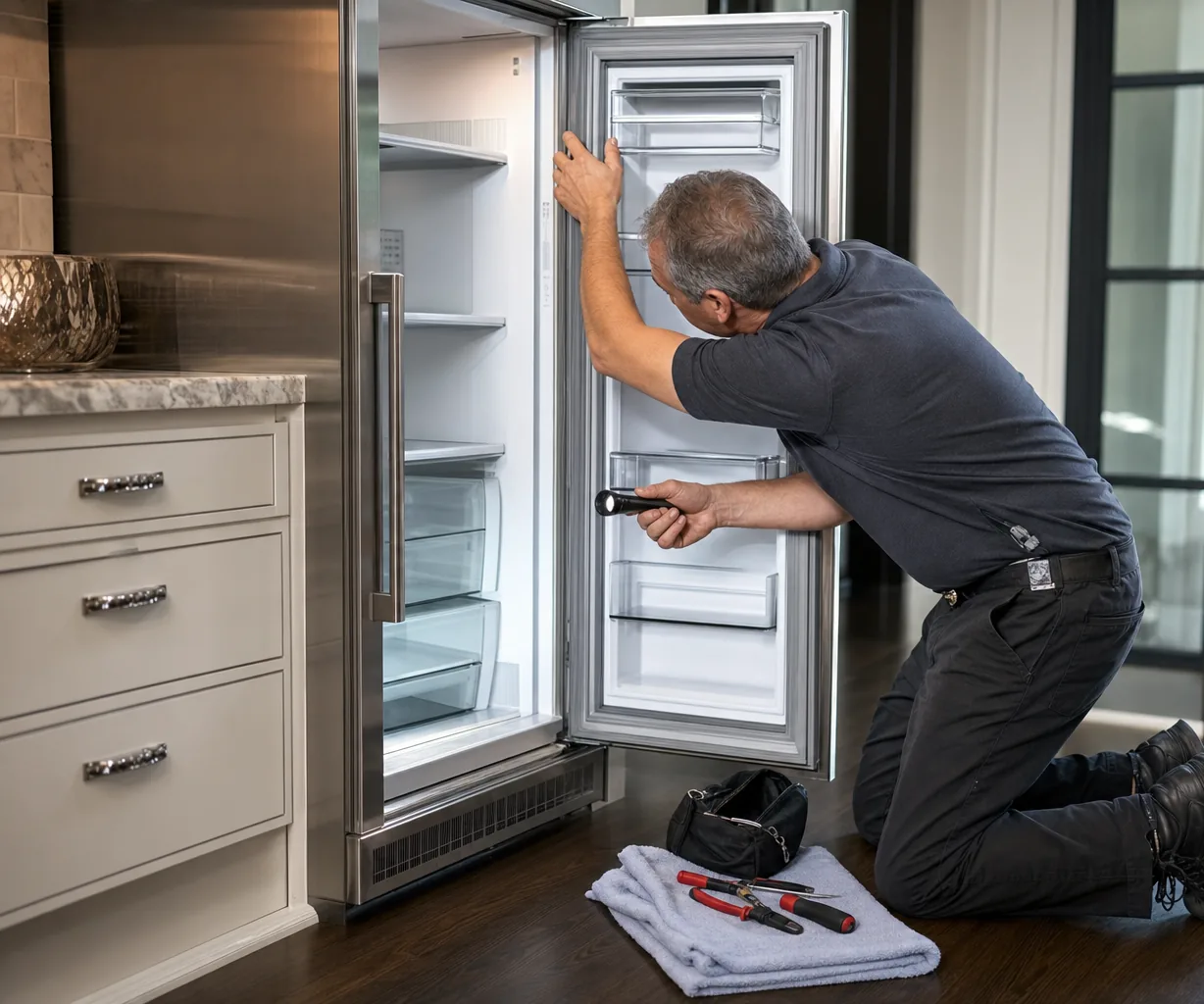
When a fridge and freezer are both not cooling, the cause is usually something the two sections share: the temperature setting, blocked airflow, a dusty condenser, a leaking door seal, a failed fan, a defrost fault or, least often, the sealed system. Work through the checks below in that order, which takes about 30 minutes, and if the fresh-food side is still above 40°F a day later, book a diagnosis, typically $95–$149.
The steps are the same on a Sub-Zero, Viking, Thermador or Miele built-in. Many older Tudors and Colonials in Fox Meadow and Greenacres have remodeled kitchens with refrigeration set flush into cabinetry, leaving the grille as the unit’s only way to breathe.
What should you check first when both sections are warm?
- Settings and mode. Set the fridge to about 37–38°F and the freezer to 0°F. Some electronic controls have a demo or showroom mode that lights the display but shuts off cooling; the owner’s manual explains how to exit it.
- Real temperature. The display reads an air sensor. Put an appliance thermometer in a glass of water on a middle shelf and read it after 24 hours.
- Door seal. Close each door on a dollar bill at several points. If it slides out with no drag, the gasket is not sealing. Look for a drawer or tall bottle holding a door open.
- Load and vents. An overpacked freezer blocks the vents that move cold air through the cabinet.
Is a dusty condenser to blame?
The condenser coil releases the cabinet’s heat. Matted with dust or pet hair, it makes both sections drift warm, especially in summer. On most Sub-Zero built-ins the condenser sits behind the top grille; undercounter models put it behind the toe-kick grille.
Turn the unit off at its control or the breaker, remove the grille, and vacuum the coil with a soft brush, moving along the fins rather than across them. Cleaning it a couple of times a year keeps most built-ins running easily.
Why is the freezer cold but the fridge warm?
In many refrigerators the fresh-food section gets its cold air from the freezer coil through a duct and damper. If frost chokes that coil, the evaporator fan stops or the damper sticks, the fridge warms first. Units with dual refrigeration, as on many Sub-Zero built-ins, have a separate fresh-food coil and fan, so look at that side’s fan, defrost parts or sensor. Snowy frost on the back panel is the clue.
A safe test is a manual defrost: empty the unit, switch it off for 24 hours with the doors open and towels down, then restart. If it cools for a few days and fails again, suspect the defrost heater, defrost thermostat or control.
Which symptoms point to which repair?
| Symptom | Likely cause | Safe owner check | Typical range |
|---|---|---|---|
| Both sections slowly warm, compressor runs nonstop | Dusty condenser or blocked grille | Clean the coil with power off | No part if cleaning fixes it |
| Bill slides out, frost near the door | Worn door gasket | Dollar-bill test | $150–$450 |
| Heavy frost on the back panel, fridge warm | Defrost heater or defrost thermostat | 24-hour manual defrost | $320–$550 |
| Freezer warm, no air from the vents | Evaporator fan motor | Listen with the door switch pressed | $300–$800 |
| Display disagrees with a thermometer | Thermostat or temperature sensor | Thermometer in water | $280–$450 |
| Condenser fan silent, compressor area hot | Condenser fan motor | Listen behind the grille | $300–$750 |
| Both sections warm, clean coil, compressor clicks | Compressor or sealed system | None; call for service | $800–$2,200 |
These are typical ranges; the firm quote is given on site after diagnosis, and the diagnostic fee is credited toward the repair if you go ahead. See the repair pricing page.
When is it a fan or the sealed system?
The condenser fan cools the coil and compressor; if it is silent while the compressor runs, cooling fades in both sections. The evaporator fan sits behind the freezer’s back panel; with the door switch held in, you should hear it and feel air at the vents. A failed fan is a common, moderately priced repair.
The sealed system is the compressor, coils and refrigerant. Warning signs are a compressor that runs constantly while the coils barely cool, no frost at all on the evaporator, or a compressor that clicks on and off every few minutes. Refrigerant work is regulated and never a homeowner job.
When should you stop and call for service?
Call if the fresh-food section is still above 40°F, or the freezer will not get near 0°F, 24 hours after you have cleaned the condenser and confirmed the settings and seals. Do not remove interior panels, chip ice with a knife, aim a hair dryer at plastic liners or add refrigerant yourself.
Scarsdale Estate Appliance Repair is an independent service, not manufacturer-authorized, working on built-in refrigeration in Scarsdale, Hartsdale, Eastchester and White Plains. Call (914) 275-0968 and describe what your checks found. More detail is on our refrigerator repair and freezer repair pages.
Frequently asked questions
Why are my fridge and freezer not cooling when the light still works?
The light only proves the unit has power; cooling depends on the compressor, fans and controls. If you cannot hear them running, check for a demo mode, then call for a diagnosis.
How long does food stay safe when the fridge and freezer stop cooling?
A closed refrigerator keeps food cold for about 4 hours and a full freezer for about 48 hours, according to USDA guidance. Discard perishables that sit above 40°F for more than 2 hours.
Can a dirty condenser stop both sections from cooling?
Yes. A dusty coil cannot shed heat, so the compressor runs longer and both sections drift warm.
Is a built-in refrigerator worth repairing when it stops cooling?
Usually, when the fault is a fan, gasket, sensor or defrost part. A sealed-system repair, typically $800–$2,200, is worth weighing against the unit’s age and condition.